
Why Traditional Travel Planning Doesn't Work Anymore (and How to Plan Traveling Instead)

If you've ever Googled "how to plan a family trip" and walked away feeling more overwhelmed than when you started, you are not doing anything wrong.
You are just using old advice for a life that no longer exists.
Traditional travel planning — the kind built around spreadsheets, six-month booking windows, and the assumption that you have unlimited time, unlimited energy, and zero competing priorities — was never designed for you. It wasn't built for the mom of four who works part-time and needs to be home by 3pm. It wasn't built for the woman carrying the entire mental load of a household while also trying to grow a business. It wasn't designed for the family with blended schedules, teenagers with sports seasons, and a budget that lives in the real world.
Quick Take:
Old travel advice creates burnout. Modern family travel planning is about building a repeatable system — points, flexible schedules, and stress-free frameworks. This approach helps busy moms and families travel intentionally without overplanning or decision fatigue.
In 2026, the gap between old travel planning and how we actually live has never been wider. And the good news is, there's a better way.
What "Traditional" Travel Planning Actually Assumes
Let's name what most travel advice was written for.
It assumes you have one primary decision-maker who can dedicate focused hours to research. It assumes your schedule is predictable from season to season. It assumes you have the emotional bandwidth to enjoy planning rather than dreading it. It assumes that "booking early" is always possible, that you have a clear idea of where you want to go, and that once the flights are booked, the hardest part is over.
For a solo traveler with a flexible job and no dependents, that advice probably works fine.

For everyone else? It creates a very specific kind of burnout.. the burnout of trying to do everything right and still not going anywhere.
I know because I lived it. As a mom of four, including three teenagers, I spent years putting travel in the "someday" category. Not because I didn't want to travel, but because every time I tried to plan a trip the way the internet told me to, I'd hit a wall. Too many tabs. Too many decisions. Too many variables. Too much.
The solution wasn't to try harder. It was to completely rethink the system.
The Hidden Problem: Travel Planning Was Never the Issue
Here's something most travel content won't tell you: the problem isn't that you're bad at planning. It's that travel planning, as it's traditionally taught, doesn't account for the mental load you're already carrying.
Mental load — the invisible cognitive work of tracking everyone's needs, anticipating problems, and managing the logistics of family life — is a real and documented phenomenon. When you sit down to "plan a trip," you're not starting from a blank slate. You're adding to a system that's already running at capacity.
Old travel planning treats every person as if they are starting from zero. Modern travel planning has to account for the fact that most women are starting from ninety.
This is also why so many families have a folder full of "trips we almost booked." The research gets done, the dream gets built, and then life happens. Something changes. The window closes. The trip gets tabled.
It's not a motivation problem. It's a systems problem.
What's Changed About Travel in 2026
It's not just us who have changed — travel has changed too, and most planning advice hasn't caught up.
Flexibility is now a feature, not a luxury. A decade ago, booking as far in advance as possible was almost always the right move. Today, airlines, hotels, and booking platforms have created far more dynamic pricing models. Sometimes the best deal appears six weeks out, not six months.
Points and rewards have matured into a real planning tool. What used to require financial engineering now requires a simple system. Families who use their everyday spending strategically — groceries, gas, utilities — can fund meaningful international travel without saving up for years. This is exactly what I teach inside the Reward Travel Starter System, and it's the foundation that makes flexible, intentional travel actually attainable for real families.
Slow travel and immersive experiences are displacing the "14 cities in 10 days" model. More families are choosing fewer destinations, longer stays, and deeper experiences over itinerary density. This is wonderful for your nervous system and terrible for traditional travel advice, which was built around quantity.
Work flexibility has changed when we can travel. Remote work, entrepreneurship, and flexible schooling mean that the rigid "summer vacation or nothing" model doesn't apply to everyone anymore. Shoulder season, off-peak windows, and school-year travel are now genuinely on the table — but only if your planning system can work with that flexibility instead of against it.
Why "How to Plan Travel in 2026" Needs a Different Answer
Searching for modern travel planning advice often returns the same listicles that would have been written in 2012: pick your destination, set a budget, book flights early, make a packing list.
That is not a planning system. That's a checklist that assumes you've already done the hard work.
A planning system for 2026 looks like this:
1. Start with your life, not your destination.
Before you pick a place, get honest about your travel windows, your family's current season, and your energy capacity. A family with a senior in high school has different constraints than one with a toddler. A mom running a business on 10–15 hours a week needs a planning process that respects that time — not one that requires 40 hours of research before a single booking is made.
2. Separate the emotional planning from the logistical planning.
One of the biggest traps of traditional travel planning is trying to do both at once. Dreaming about Paris and pricing flights to Paris are two completely different mental activities. Doing them simultaneously creates decision fatigue before you've even started.
Give yourself permission to dream first. Build your travel vision — the feeling you want, the kind of experience you're looking for, the memories you're trying to create — before you touch a single search engine. On the Her Travel Club YouTube channel, I walk through this process in a way that makes it visible, not abstract.
3. Know your points before you know your destination.
This is one of the biggest shifts in intentional travel planning, and it's one most families haven't made yet. If you know what points you have, what programs you're earning into, and what sweet spots exist in those programs, you can let your points shape your destination choices rather than trying to retrofit points onto a trip you've already decided to take.
That's the difference between strategic travel and expensive travel. I break down exactly how this works in the free Reward Travel Guide — and it's the same philosophy behind every article in the Her Travel Club blog.
4. Build a budget that covers the whole experience.
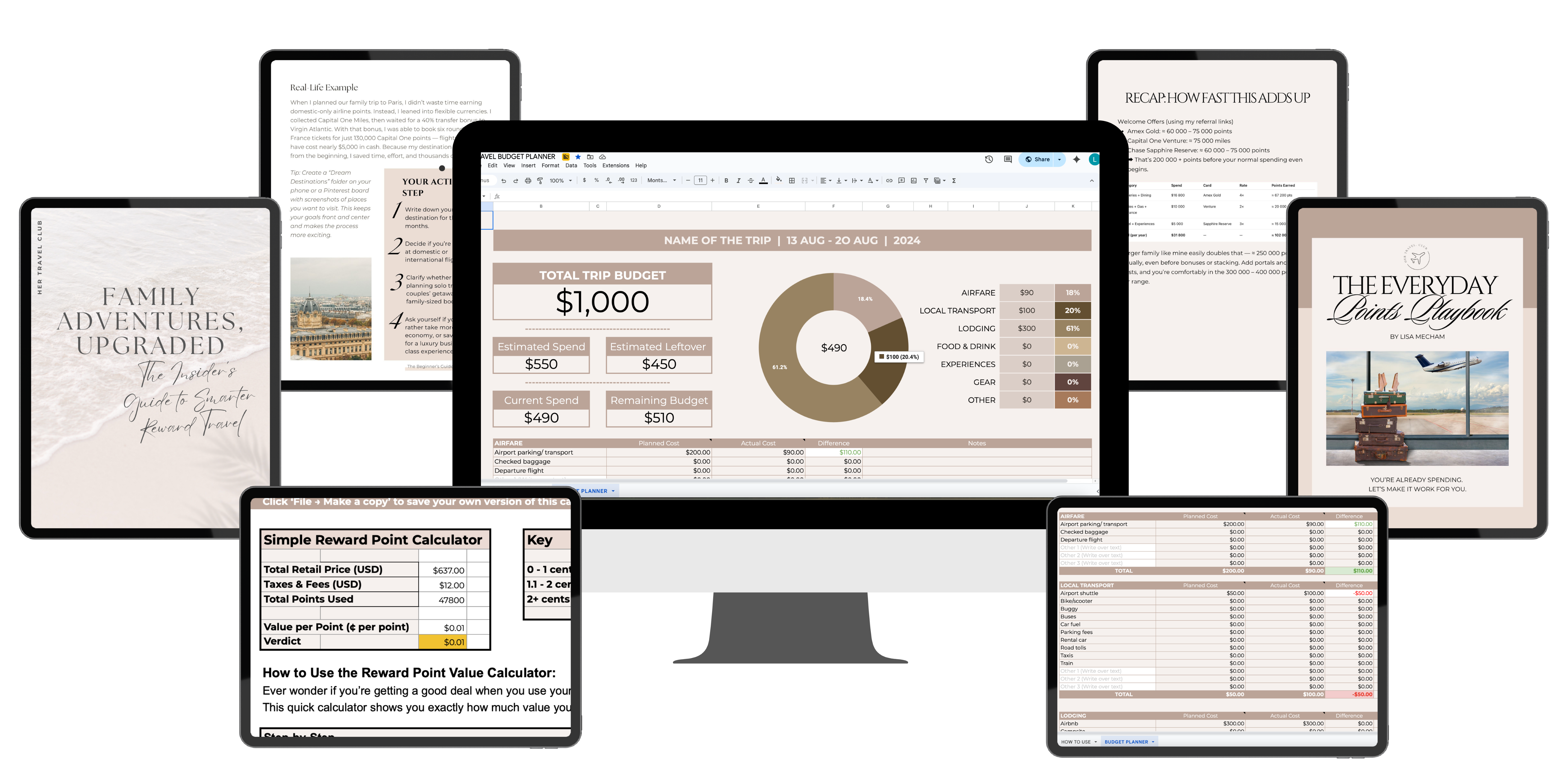
One of the silent killers of family travel joy is arriving financially unprepared for the part points don't cover. Flights and hotels might be free. The food, transportation, experiences, and spontaneous moments are not. The Travel Budget Plannerwas built specifically for this — an auto-calculating tool that tracks every category so nothing sneaks up on you after you land.
5. Leave room for the trip to breathe.
Intentional travel planning isn't over-planning. There is a real difference between having a plan and having a schedule. Modern travel — especially with families — benefits enormously from built-in unstructured time. The magic usually happens in the margins, not the itinerary.

The Shift: From Trip Planning to Travel Systems
Here's the reframe that changes everything:
Stop planning trips. Start building a travel system.
A trip is a one-time event with a beginning and an end. A travel system is an ongoing infrastructure that makes travel a regular, predictable part of your family's life, regardless of income level or schedule complexity.
A travel system includes:
- A consistent earning strategy for points (what cards you use, how you shop, how you maximize everyday spending)
- A simple tracking method so you always know what you have
- A flexible planning framework that works within your actual schedule
- A budget tool that covers the full trip experience
- A trusted resource you return to when you have questions
That last one matters more than people realize. One of the reasons traditional travel planning creates so much decision fatigue is the sheer noise of conflicting information. Having a single, values-aligned source you trust — for points strategy, destination research, booking logistics — reduces the cognitive load enormously.
That's the whole reason Her Travel Club exists.
What Adaptive, Systems-Based Travel Planning Actually Looks Like
Let me make this concrete.
Last year, I took my family of four to five countries — France, the Netherlands, Switzerland, Germany, and Mexico — plus domestic trips to Las Vegas and Santa Fe. We did all of it on points.
That didn't happen because I spent hundreds of hours planning. It happened because I had a system that ran quietly in the background of everyday life. My everyday spending earned transferable points. I knew which programs held the best value for our family's travel profile. When a good booking window opened, I could move on it quickly because the foundation was already in place.
That's what a travel system does. It collapses the distance between dream and departure.
If you're starting from scratch, the Reward Travel Starter System is the most direct path to building that foundation. At $39, it includes the tools, strategies, and calculators that show you exactly how to turn your current spending into future flights — for a family of any size.
If you want to see the travel plan template process in action before you buy anything, the Her Travel Club YouTube channel shows the full strategy step by step — from earning points to booking flights — in real-life scenarios.
And if you're still in the early stages of figuring out whether this is even possible for your family, the free Reward Travel Guide is the right place to begin. It answers the questions most women have before they're ready to ask them.
A Note on Safety, Burnout, and Why This Actually Matters
I want to say something that doesn't get said often enough in travel content:
Planning fatigue is real, and it has real consequences.
When travel planning becomes one more item on an already impossible to-do list, families stop traveling. And the cost of that isn't just the trips you didn't take — it's the experiences your children didn't have, the memories that weren't made, the perspective that didn't get built.
Kids don't remember the gifts you gave them. They remember the trips. The morning they tasted their first croissant in Paris. The afternoon they stood at the edge of something ancient and enormous. The version of themselves they discovered when they were somewhere new.
That's not a marketing claim. That's what I know from watching it happen in my own family, and it's why I take the friction out of this process as seriously as I do.
Modern travel planning, done well, should feel like relief. Not another obligation.
Where to Start Today
If this article named something you've been feeling but couldn't quite articulate, here's your next step:
New to reward travel? → Download the free guide and start with the money you already spend.
Ready to build your travel system? → Get the Reward Travel Starter System for $39 and get the full toolkit in one place.
Want to see how it works before you commit? → Watch the Her Travel Club YouTube channel for real walkthroughs and strategy breakdowns.
Planning a specific trip and need expert help? → Work with me as your FORA travel advisor for personalized booking support and exclusive perks.
Disclosures
Affiliate Disclosure: This post contains affiliate links to products and services I personally use and recommend, including credit card offers. If you click a link and make a purchase or apply for a card, I may receive a commission at no additional cost to you. This helps support the free content I create at Her Travel Club.
Travel Advisor Disclosure: I am a FORA-affiliated travel advisor (IATA #33520476). When I assist clients with bookings, I may earn a commission from hotels, tour operators, or travel suppliers. This does not affect the advice I provide.
Financial Education Disclaimer: The information in this article is for educational and entertainment purposes only. I am not a licensed financial advisor, and nothing here should be construed as personalized financial advice. Credit card rewards strategies involve personal financial decisions. Please do your own research or consult a licensed professional before opening new credit accounts or making financial decisions.
Content Accuracy: Travel programs, point values, card benefits, and booking strategies change frequently. Always verify current terms directly with airlines, hotels, and card issuers before making decisions.
Lisa Mecham is the founder of Her Travel Club, a FORA-affiliated travel advisor, and a mom of four based in Salt Lake City. She teaches women and families how to use reward points to travel internationally — without spending more or needing a finance degree. Follow along on YouTube and at HerTravel.Club.